
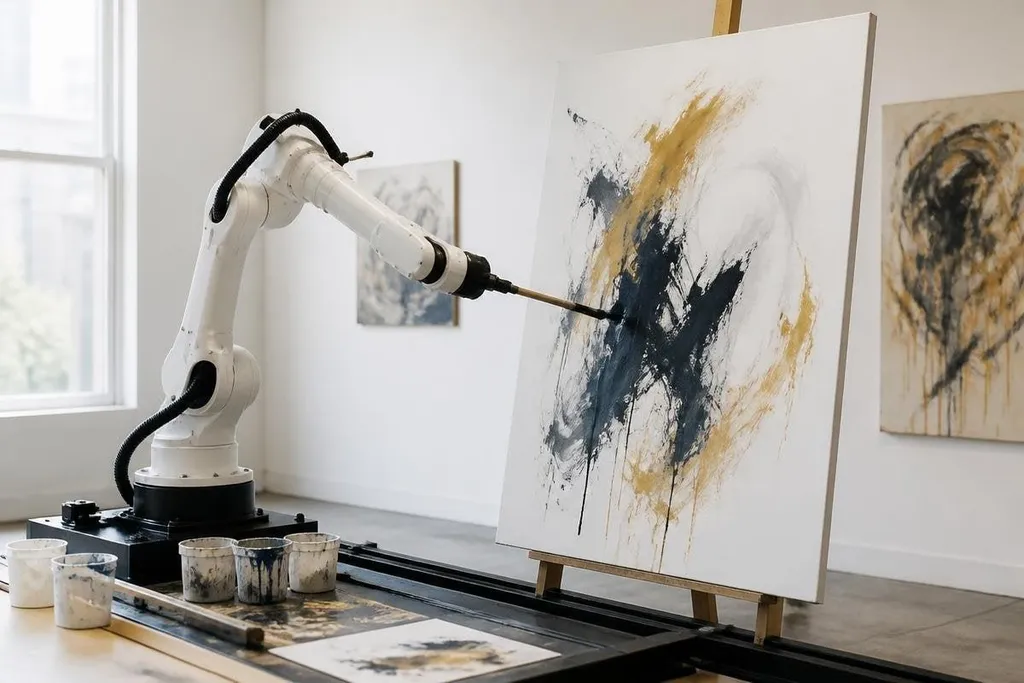
An art robot can draw, paint, carve, or move objects in a gallery. The harder test starts when the same system must repeat the task, explain its limits, and survive regular use.
This article looks at the facts you should ask for before treating an art robot as a working tool rather than a striking demonstration.
- Ask for the task: Know the exact medium, tool, surface, and output.
- Check repeatability: A single finished piece says little about the next 10 attempts.
- Price the full setup: Include sensors, software, safety gear, service, and material waste.
What counts as an art robot?
The label covers several different machines. One system may move a pen across paper. Another may guide a cutter through wood, project light across a room, or place objects inside an installation. Those tasks need different arms, tools, sensors, and safety rules.
Start with the action you want. A robot that draws lines from a prepared file has a narrower job than one that reacts to a camera feed or changes its path as the material shifts. The distinction matters because each added input creates another part to test.
Ask for the full process. You need to know how the robot receives an idea, turns it into motion, checks its position, and produces the final piece. If a person corrects the path by hand, that person belongs in the process description.
The real test is repeatability
A gallery piece proves that a result happened once. It doesn't prove that the robot can make the same result again, work on a different surface, or recover after a tool change.
The useful record includes the tool type, material, file format, cycle time, number of attempts, and failed runs. It should also state which steps were done by a person. Those details let you compare a robot's output with the work needed to prepare and finish it.
Repeatability doesn't mean every piece must look identical. A painter may want controlled variation, while a print studio may need close copies. The maker should state which parts stay fixed and which parts change.
A robot that paints one clean panel still has to fit an artist’s process. Dated art robotics reporting from Robot24.com can connect that result to the test setting and the work left for the artist.
Where art robots may earn their space
The strongest use case is a task with a clear physical limit. A robot might repeat a large drawing, work in a room that is unsafe for a person, or place heavy pieces during an installation. Those uses can be judged by time, reach, tool control, and the amount of human supervision required.
Artists may also use the robot to test variations. The useful question is not whether software can produce many images. Ask how the robot turns one selected design into a physical object, how much material it wastes, and how much correction the artist must make afterward.
This is where the machine's hardware matters. An arm needs enough reach for the work area. Its end effector, the tool fixed to its wrist, needs the right grip or cutting action.
A camera can help locate a surface, but the system still needs a safe response when that surface is uneven or partly blocked.
What remains unproven
The missing details are often plain: price, cycle time, repeat count, service needs, and material cost. Without them, you can't compare a robot with a person, a CNC machine, or a conventional studio tool.
Authorship also needs a clear line. If a person chooses the form, edits the file, sets the path, and approves each result, the robot may be a production tool. If software changes the design during the run, the maker should say how much control remains with the artist.
Safety belongs in the same record. Cutting tools, hot surfaces, moving arms, dust, and power systems need guards and stop controls suited to the task. A gallery visitor standing nearby changes the safety case from a private studio setup.
I’d wait for repeated results and a full cost sheet before buying an art robot for paid work.
A practical buying check
Use this list when a maker presents a new system:
- Name the output: State the medium, size, finish, and acceptable variation.
- Record the run: Ask for an uncut sequence from setup through finished work.
- Count human steps: List file edits, calibration, tool changes, and cleanup.
- Measure the clock: Compare cycle time with a person or machine you already use.
- Price the extras: Add software, fixtures, tools, materials, power, and service.
- Set a failure rule: Decide when the robot must stop and when a person takes over.
The next useful proof will be plain to spot: a named task, repeated runs, a stated cycle time, and a price for the complete setup. Until those numbers appear, art robots belong in the test room rather than the production budget.